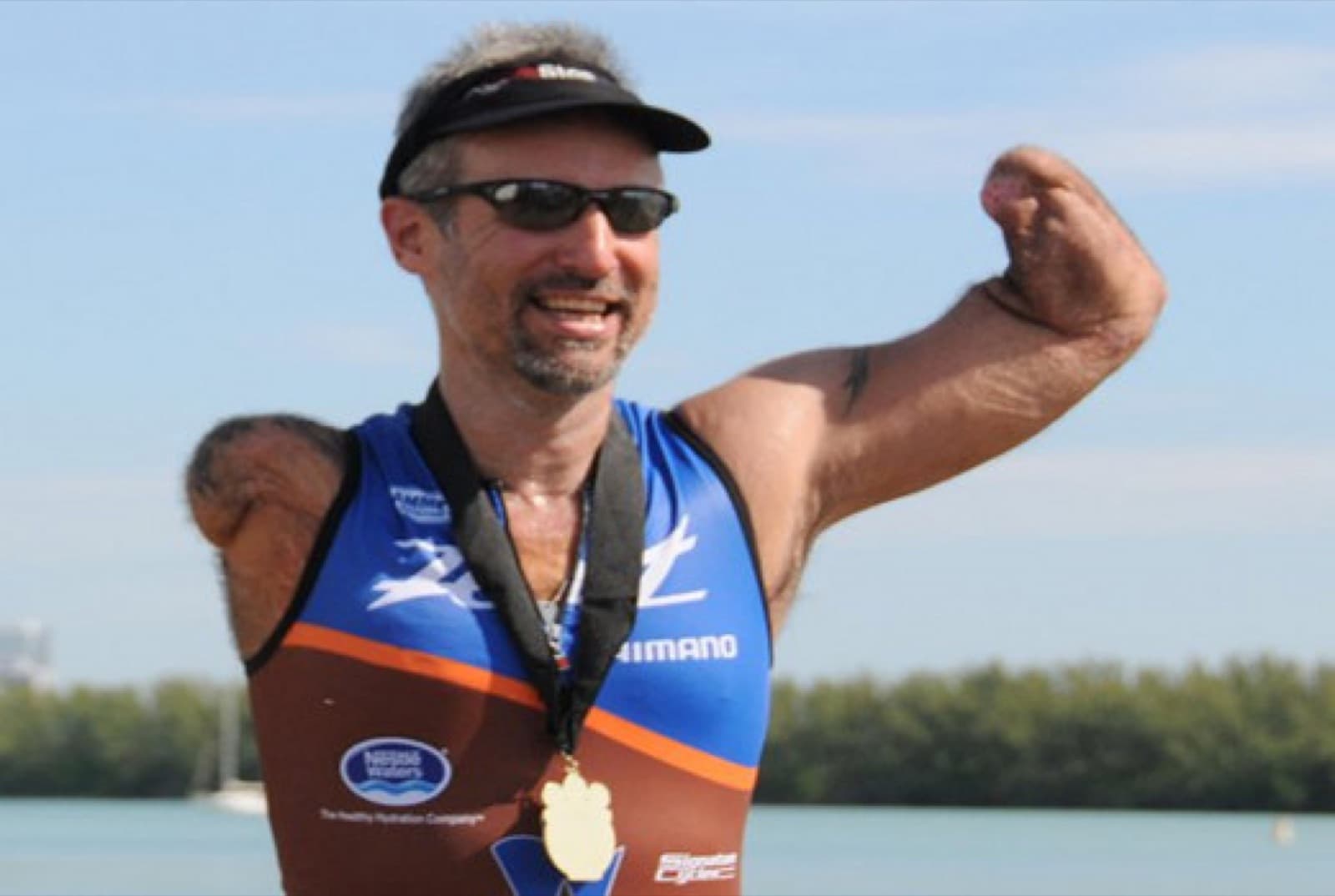
What does it take to compete in a sport built around swimming, biking, and running — with no arms? On the last day of March 1992, 13,000 volts of electricity surged through the body of Hector Picard, born to Cuban parents and now married to Wendy Picard, with four children and two grandchildren. At the time, he worked as an electrician for the power company, servicing a substation transformer in Hollywood, Florida — a structure the size of a two-story building that supplies power to entire neighborhoods. Near the end of his shift, Picard was walking between two wires. One was live. The other was not.
Electricity surged through his right hand and blew off part of his right foot as the current exited his body. As he fell, he instinctively grabbed the wire with his left hand — and 13,000 volts struck him a second time, passing through his left hand and out his hip. He fell two stories to the ground, his torso in flames.
His chances of survival were slim. Doctors airlifted him to a hospital in Gainesville, where he spent the first month in a coma, hallucinating that doctors were cutting him apart and nurses were taking advantage of him. When he finally woke, he didn't recognize his surroundings. He couldn't speak — there was a hole in his throat — and he couldn't move, strapped down to the bed. He learned the rest of what happened to him only later, in pieces, from others: he had made a turn to climb one side of the structure, not realizing the wire he reached for was live.
Thermal burns — an agonizing injury that chars tissue from the inside out — forced doctors to perform more than five surgeries. As a last resort, they amputated both of his arms: his right at the shoulder, his left midway down the forearm, leaving burn scars across much of his upper torso. Doctors told him he would relearn how to button a shirt, brush his hair, and feed himself — all the things learned as a child. At 24, it became clear he would have to start his life over, as a bilateral amputee.
The expected questions surfaced: "Why me?" Then: "How do I drive, eat, use the bathroom?" To Picard, these were simply obstacles to overcome — and he refuses to let anyone say "I can't" around him. "That's the word I hate the most," he says. He began physical therapy in the hospital. About two weeks before his release, a fellow amputee visited, hoping to lift his spirits — instead, Picard says, the visit left him depressed.
With the support of his family and friends, he pushed past the obstacles in front of him and went further than anyone expected. With a one-year-old daughter still in diapers, Hector set out to rebuild his life. He credits much of his recovery to Cheryl Miller, OTR/L, the occupational therapist and national director of Therapy Operations at HealthSouth Corporation who worked with him at HealthSouth Sunrise Rehab Hospital. From his first day there, she recognized he had serious long-term challenges ahead — but also that his disposition meant he was going to be okay. Picard quickly relearned simple tasks: turning on a radio, a television, the lights in his room.
Within five months of the accident, Hector was fitted with his first prosthesis — a body-powered hook for his dominant left hand. A month later came his first myoelectric arm, also for that hand. Miller trained him to use it by practicing with an egg and a soda can; at first he crushed both. Before long, he'd mastered the control needed to handle them gently. Today, his arm of choice is the MyoHand VariPlus Speed from Otto Bock HealthCare, though he still uses a hook for heavy work like landscaping and painting. He has tried prosthetics for his right hand, but the burn scars on his chest make them uncomfortable to wear on that side.
About six years after the accident, Hector had recovered enough to return to work. He earned a real estate license and made a good living selling homes until the market crashed in 2008. He went through a divorce after twenty years of marriage, and in 2010 met Wendy, whom he married that August.
Hector was introduced to triathlon by a couple he met at his local gym, who suggested it after watching him in a spin class. His first reaction was that anyone who did triathlons was crazy. Swimming without hands, he realized, was an easy problem — he simply swims on his back. Steering a bike at 30 miles per hour without hands, and braking, was harder. A bike shop told him it couldn't be done. That was all the motivation he needed: he bought a $100 bike, picked up some bolts and spare sprinkler and plumbing parts, and built what "couldn't be done" himself.
Hector completed his first triathlon in 2009, finishing 674th out of 728 — ahead of his able-bodied younger brother — and went on to race eight triathlons that year. In 2010, he competed in 22 triathlons across Florida, and has since raced 20 more nationwide, including in Puerto Rico. Then, racing a 2.4-mile swim, a 112-mile bike, and a 26.2-mile marathon, Hector Picard became the first double-arm amputee to finish an Ironman triathlon — crossing the line in 16 hours and 42 minutes, greeted by that year's overall winner, Jordan Rapp, and the voice of Ironman, Mike Reilly. He has since finished four Ironman races.
Hector has turned his disability into a way of helping others. Through the "Tri for BCC Kids" event alone, he has helped raise more than $10,000 for the Broward Children's Center, covering a combined 250 miles of swimming, biking, and running — a 5-mile swim, 200-mile bike, and 50-mile run — to support a nonprofit that has provided medical and educational services to children with special health-care needs for more than 40 years. He later extended the effort with "300 Miles in 24 Hours for BCC Kids." Going the distance is nothing new for him: one of his biggest feats was an attempted 30-day, cross-country cycling trip from Miami, Florida to Spokane, Washington, to raise money for prosthetic hands for a toddler, Jameson Davis, born without arms. The ride took 36 days and covered roughly 3,100 miles, raising more than $20,000 for the cause.
"As children we are always encouraged to dream — to be astronauts, cowboys, even professional athletes. Unfortunately, as we grow older, our dreams fall to realistic goals and responsibilities. My journey as an amputee began with obstacles I never imagined. I was an active person with a family and dreams of more than merely existing. I needed to find a way to be active again, to be there for my family. I didn't want to stop living — I wanted to experience life with the same zeal I had before my accident," he says.
Hector has completed two long-distance, unassisted cross-country bike rides — from Fort Lauderdale to New York City in 2012, and later from Miami to Spokane. His creative approach to fundraising has been televised nationally. A 2010 Paul Mitchell Spirit Award winner and 2012 USAT Jeff Jewell Spirit Award winner, he draws strength from the support of family, friends, and fellow competitors. "In life you are constantly encountering new challenges that remind us we are living, evolving beings," Hector says. "My support system has changed over the years, but my desire to live a full life has not. That's why I started an organization called 'Don't Stop Living' — a resource for anyone facing obstacles, whether disabled, struggling personally, or just down on their luck. I want everyone to know that no adversity is too great when you embrace life through hard work and positive thinking. You will overcome anything."
Hector is also a motivational speaker, traveling the country to share his "Don't Stop Living" message — also the name of his website, www.dontstopliving.org. To support his charitable missions, visit www.bcckids.org. Hector also supports the I Will Foundation, founded by Matthew Long — an FDNY member, Ironman finisher, and survivor who was struck by a bus during a 2005 transit strike in New York City and given less than a 5% chance of survival. Learn more at www.iwillfoundation.com.