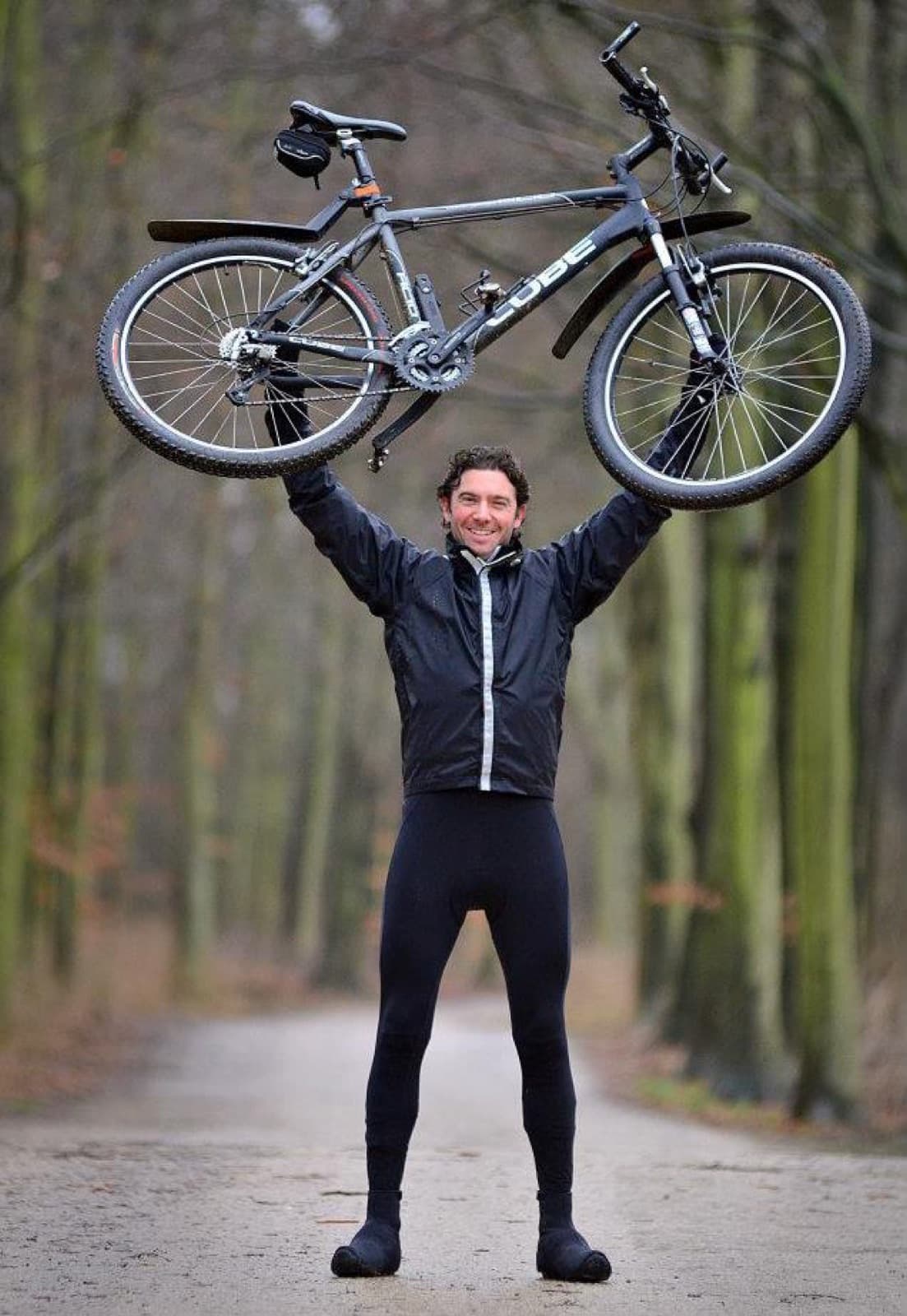
Wouter Duinisveld was born in 1977 in Voorburg, in the western Netherlands, and works as a project manager and quality and innovation manager at Safety Haaglanden. Sporty since childhood, he played rugby for the Hague Rugby Club and youth selection teams until a shoulder injury forced him to quit at 20. He took up running in 2006 and discovered triathlon soon after, joining Triathlon Club Residence in The Hague with his sights set on completing a full-distance race. Then his health intervened: he contracted viral myocarditis, a virus that destroyed his heart.
The infection reduced his heart function to below 15 percent within two weeks, and doctors told him a heart transplant was his only chance of survival. Before a donor heart became available, he suffered four cardiac arrests. He was transferred from Bronovo to the transplant department at Erasmus Hospital in Rotterdam for evaluation. In early 2007, his condition deteriorated rapidly: after a severe bout of stomach flu forced him into quarantine, four further cardiac arrests reduced his heart function to just 5 percent, and doctors implanted a ventricular assist device to keep him alive.
Wouter lived with that artificial heart for months — battery-powered by day, plugged into an outlet at night. Walking to the corner of the street took everything he had; his body had lost nearly all its strength, and he had to relearn how to sit, stand, and walk. After roughly nine months on the device, a donor heart became available, and Wouter began a new life. Getting fit and living as healthily as possible became his focus — and since sport was already his passion, it was a natural fit.
After months in the hospital, Wouter was finally able to go home by the end of April. Returning to his own bed, drinking coffee in the sun, walking the beach with his girlfriend — ordinary routines he now cherished deeply. But he had to stay careful: his new heart came with real limits. "I had a limited physical condition, a continuous risk of infection, and risk of failure of the device," Wouter remembers. The medication he needed, and the heart's own limits, ruled out extreme exertion — but doctors told him endurance sport was actually well suited to his recovery, letting him monitor his heart rate carefully while working toward his best possible condition.
"Receiving a donated organ is, fortunately, a subject most of us feel is far removed from our own lives," Wouter says. Healthy, active people rarely fear their bodies will fail them suddenly — that was Wouter's outlook too, until the day he was admitted with heart problems. "This news was unreal. I'd never been so devastated. My life stopped. I had so much I wanted to do. I wanted to live with my girlfriend," he remembers.
After his rehabilitation, Wouter returned to training. "I was just fascinated by triathlon, and I wanted to finish one," he says. He'd long dreamed of becoming an Ironman, and two years later, in 2010, he completed his first triathlon — becoming only the third heart-transplant recipient ever known to do so. He went on to finish Ironman 70.3 Mallorca — a 1.2-mile swim, 56-mile bike ride, and half-marathon. On July 6, 2014, he made his full Ironman dream real, finishing the 2.4-mile swim, 112-mile bike, and 26.2-mile marathon at Ironman Frankfurt — one of the few heart-transplant recipients ever to complete the distance.
It's still hard for Wouter to fully grasp what happened. In 2007, he, his family, and his friends went through hell — "but at the same time, we're fortunate to have made it through," he says. "Luckily, I've been given a new chance to live." That gift has made his love of biking, walking, and running — and the opportunities life has given him since — all the more meaningful.
Wouter wants to combine his passion for sport with a mission to find more organ donors, showing that a donated organ can give someone a new life in which dreams are still possible. He hopes to inspire anyone waiting for a donor organ, or living with one, and wants to honor his own donor every day by chasing his dreams. He found a natural home for that mission with Team4Talent. "I think it's great to be part of a team of ambitious, talented people, each with their own background. By forming a team, each member can develop their own talent and keep working toward their own dreams and goals. I firmly believe in it," he says.
Wouter had already built a career as an independent personal trainer and group instructor around his hometown of The Hague, but one conversation pushed him further: Casper Visser of International Health Spa encouraged him to open his own business. "That is what I wanted: my own, high-quality personal training studio. A dream was born," Wouter says. Now that he's realized that dream, he's looking ahead to what comes next. "I get to share my dream with the people I train in my gym — the goals we'll achieve together, the fun we'll have working out. I'm already looking forward to it," he says.
Organ donation gives people like Wouter a second chance at life, and he remains deeply grateful to the donor who gave him his heart. Through his story, he hopes to raise awareness — registering as a donor takes less time than warming up for a run, and it can help someone live a longer, healthier life. He also wants to raise awareness of myocarditis, the disease that nearly killed him, which inflames the heart muscle until it can no longer pump effectively; in most cases, a heart transplant is the only cure. Learn more at www.ikworddonor.nl. Team4Talent brings together athletes with international potential, offering the guidance to help each one learn, grow, and fulfill their goals — visit www.team4talent.com. To learn more about Wouter and his book, "The Heartbeat of Another: From Transplantation to Triathlon," visit www.wouterduinisveld.nl.